Unlocking the Potential of Barley for Swine Nutrition
Estimated reading time: 7 minutes
Author Serra McSymytz, Communications Manager, SaskBarley. Reviewed by Dr. Ruurd Zijlstra, University of Alberta.
For decades, barley was kept out of nursery pig diets. New research from the University of Manitoba and the University of Alberta suggests that caution may be outdated, and that barley’s fibre could help young pigs as antibiotics and zinc oxide face pressure as gut-health tools.
Key takeaways:
- Barley fully replaced wheat in a nursery pig growth trial with equal growth performance, once diets were reformulated for energy and amino acids.
- Early testing showed barley particles can act as a decoy for E. coli, the bacteria behind post-weaning diarrhea. Live disease-challenge trials are still ahead.
- With antibiotic growth promoters restricted and zinc oxide’s future uncertain, barley is being tested as a dietary tool for gut health.
- No formal cost comparison against wheat or corn has been run yet, so the economics are still open.
- Barley (like wheat) produces whiter pork fat than corn, a quality trait valued in premium Asian pork markets.
Dr. Martin Nyachoti (University of Manitoba) and Dr. Ruurd Zijlstra (University of Alberta) are leading research to better understand how barley and its fibre fractions can be used to improve gut health, feed efficiency, and overall performance in young pigs. The work is part of the National Barley Cluster under the Sustainable Canadian Agricultural Partnership and is now roughly halfway through its five-year term.
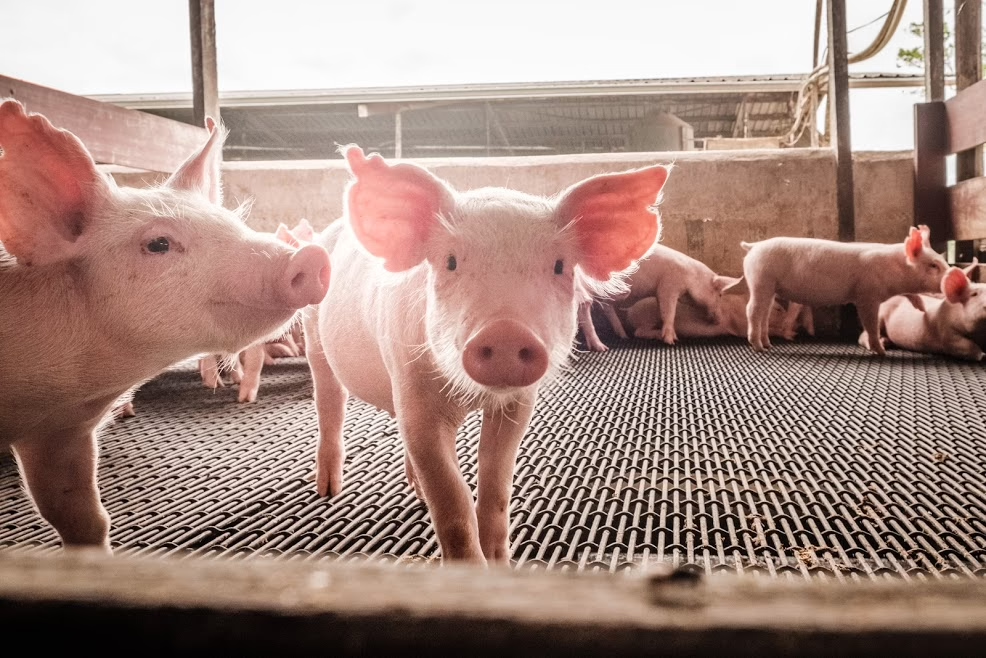
Can barley be fed to nursery pigs?
Historically, barley in Western Canada was fed almost exclusively to finishing pigs. Because it has a lower energy content than wheat, nutritionists used it to dial back energy density as pigs approached slaughter weight, keeping them from getting too fat. Nursery pigs were a different story entirely.
“Thirty years ago, barley was definitely not fed to nursery pigs — nobody would do that,” says Zijlstra, who has worked in Western Canadian barley research for almost three decades. “It was kind of a no-no, because nutritionists were really afraid about the beta-glucans, the high fibre content, that would prevent pigs from reaching their feed intake potential and therefore they would grow less.”
That thinking is shifting. Several trials, including this project, have found the opposite: some nutritionists are now including barley in nursery diets based on research showing nursery pigs fed barley perform better than assumed. The timing lines up with a bigger industry shift. Antibiotic growth promoters are no longer permitted in Canadian swine diets without a veterinary prescription — preventative antibiotics are no longer used. Instead, zinc oxide has become a major tool for controlling post-weaning diarrhea. But, following the lead of the European Union, Canada may also ban this practice, though timelines are uncertain.
“One of the tools to control gut health was removed. The second tool might be removed in the near future,” Zijlstra says. “So, there are all kinds of reasons to look at what alternatives are there to control gut health using dietary means. That’s where barley may have a role to play.”
Fractionating barley to find what matters
To isolate which part of the barley kernel drives the gut-health benefit, the team works with Rex Newkirk at the University of Saskatchewan, whose pilot-scale fractionation equipment can separate barley into whole-grain, endosperm, and germ fractions. Cultivar selection runs through Dr. Aaron Beattie at the Crop Development Centre — the project uses CDC Churchill, chosen for its increasing popularity and expected market share by the time the project wraps up rather than for any unusual fibre profile. The project also has a poultry component, led by Dr. Anna Rogiewicz at the University of Manitoba.
“We know that cultivar selection is important — not all cultivars are the same,” Zijlstra says. “We don’t want to go down a rabbit hole with a cultivar, and by the time the project is done, nobody’s growing it.”
Barley’s fibre isn’t one thing: it contains rapidly fermentable soluble fibre (beta-glucans) alongside slower-fermenting insoluble fibre, and it’s still an open question which one matters most for gut health. “We’re trying, through an array of trials, to figure out whether it’s the rapidly fermentable beta-glucan or the more insoluble fibre that plays an important role in controlling gut health in young pigs,” Zijlstra says.
What the research shows so far: barley can replace wheat in nursery diets
Two pieces of the work are complete. The first tested whether barley particles could act as a decoy in the gut — giving E. coli, the bacteria behind post-weaning diarrhea, something to bind to besides the gut wall. “We clearly showed that could happen,” Zijlstra says.
The second was a growth trial comparing a wheat-based control diet against a range of barley diets. Fully replacing wheat with barley, once diets were properly reformulated for energy and amino acids, achieved equal growth performance.
“Barley should not be underestimated as a feed ingredient to support growth in young pigs,” Zijlstra says.
What’s still ahead
The remaining work will test whether intact, processed, and enzyme-treated barley fibre can reduce E. coli severity and post-weaning diarrhea using live disease-challenge models — and whether any functional benefit can be delivered without sacrificing lean gain, since higher-fibre cultivars may yield less. Economics are also still an open question: no formal cost comparison between barley and wheat (or corn, in regions where that’s the alternative) has been run yet.
As a side note unrelated to gut health, Zijlstra pointed out barley (like wheat) produces whiter pork fat than corn-fed pigs — a quality trait valued in premium Asian pork markets, and one more reason barley holds an edge as a swine feed grain.
What it could mean for hog producers
If the remaining work confirms these early results, producers could see reduced feed cost, improved feed efficiency, better gut health and welfare, reduced reliance on antibiotic and zinc oxide interventions, and stronger protection against E. coli-driven disease.
Conclusion
This project helps reposition barley grain from a traditional feed grain to a functional nutritional ingredient. With antibiotics and zinc oxide both under pressure as gut-health tools, barley’s unique fibre profile may fill a real gap — and with these building-block studies already complete, the remaining work will determine how far that potential goes.
Originally published in the Fall 2026 issue of BarleyBin Magazine.
Frequently Asked Questions
Can you feed barley to nursery pigs?
Research says yes. Nutritionists once avoided barley in nursery diets, worried that beta-glucans and high fibre would limit feed intake and slow growth. In a growth trial in this project, fully replacing wheat with barley, once diets were properly reformulated for energy and amino acids, achieved equal growth performance in young pigs.
Why is barley being studied for pig gut health?
Antibiotic growth promoters are no longer permitted in Canadian swine diets without a veterinary prescription, and zinc oxide, now a major tool against post-weaning diarrhea, may also be banned in Canada, following the European Union. Timelines are uncertain. Researchers are testing whether barley can help control gut health through diet instead.
How could barley fibre protect young pigs from E. coli?
Early testing showed barley particles can act as a decoy in the gut, giving E. coli, the bacteria behind post-weaning diarrhea, something to bind to besides the gut wall. Remaining work will test whether intact, processed and enzyme-treated barley fibre reduces E. coli severity and post-weaning diarrhea using live disease-challenge models.
Does feeding barley affect pork quality?
Barley, like wheat, produces whiter pork fat than corn-fed pigs, a trait valued in premium Asian pork markets, according to Dr. Ruurd Zijlstra of the University of Alberta. It is unrelated to the gut-health work, but it is one more reason barley holds an edge as a swine feed grain.
Is barley cheaper than wheat or corn in pig diets?
That is still an open question. No formal cost comparison between barley and wheat, or corn in regions where that is the alternative, has been run yet. If the remaining research confirms early results, producers could see reduced feed cost and improved feed efficiency, but economics will need to be tested.
Related reading on BarleyBin.ca
- More feed barley articles
- Managing DON in Swine Diets: Economic and Practical Insights for Grower-Finisher Pigs — what mycotoxin-affected barley costs in the finisher barn.
- Beyond Malt: Fundamentals of Marketing Barley for Feed — how feed barley is priced and marketed in Saskatchewan.
- Breeding Better DON-Resistant Barley: Inside Five Years of CDC Research — more from the Crop Development Centre barley breeding program.