Breeding Better DON-Resistant Barley: Inside Five Years of CDC Research
Estimated reading time: 5 minutes
By Mitchell Japp, Research & Extension Manager, SaskBarley
Fusarium head blight (FHB) is the barley industry’s most stubborn opponent, and its real economic bite comes from deoxynivalenol (DON), a mycotoxin that can knock an entire load out of malt contention overnight. A now completed five-year research project at the University of Saskatchewan’s Crop Development Centre (CDC) shows both how much progress has been made on DON-resistant barley breeding, and how new genomic tools are about to make that progress faster.
Key Takeaways
- CDC screened roughly 2,250 breeding lines a year for five years, and the program’s in-house DON testing now matches commercial lab accuracy (r=0.96).
- A new genomic selection model can predict a breeding line’s DON risk directly from its DNA, letting breeders cull poor performers years before a line ever reaches a multi-year field nursery.
- Three new varieties have already reached commercial release with intermediate-to-moderate FHB resistance — CDC Harness, CDC Dillinger and CDC Pristine — with more in the registration pipeline.
- DON resistance ratings in the SaskSeed Guide reflect a breeding pipeline that’s actively improving; choosing an intermediate- or moderate-resistance variety remains your best defense where FHB pressure is a recurring risk.
Economic Impact
The tolerances for DON are unforgiving. Malting and brewing barley tops out at 0.5 parts per million (ppm) DON, swine and dairy calf feed at 5.0 ppm, and beef or dairy cattle feed at 10.0 ppm. With roughly a $55-per-tonne historical gap between malt and feed barley prices, a load bumped down a grade due to DON can mean a loss of around $200 per hectare. Industry-wide, FHB has been estimated to cost the Canadian cereal sector $50 to $300 million annually since the 1990s. Genetic resistance, paired with agronomic practices like crop rotation, seed treatment and well-timed fungicide application, remains the most cost-effective way to keep those losses down — which is exactly why SaskBarley keeps investing in new and improved varieties.
Screening Thousands of Lines a Year
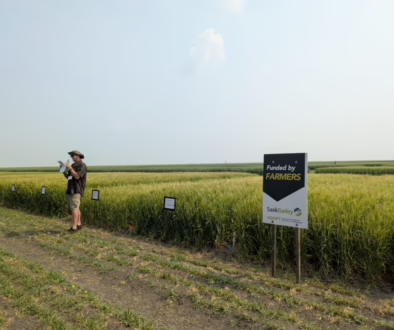
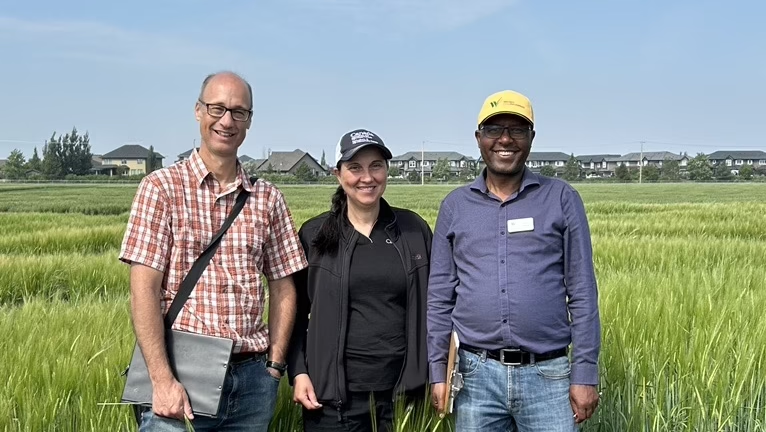
The five-year project (2021–2026), led by Dr. Aaron Beattie at the CDC, tackled FHB resistance from the applied end of the breeding pipeline, with collaborators Dr. James Tucker and Dr. Ana Badea at AAFC-Brandon. Each year, roughly 2,250 CDC breeding lines — spanning malt, feed, forage and hulless classes — were grown in a collaborative FHB nursery at AAFC-Brandon, hand-inoculated with Fusarium graminearum over several weeks, then tested for DON. The CDC’s in-house DON testing, using rapid immunoassay kits, was cross-checked against a commercial lab at the University of Guelph and came back with a correlation of 0.96 — confirmation that the faster, in-house results are reliable enough to guide selection on their own. In most years, 22 to 32 percent of malt lines and a comparable share of feed and forage lines matched or beat the resistance benchmark set by the low-DON check variety CDC Mindon.
A Genomic Shortcut for Breeders
The project’s second objective was building a genomic selection (GS) model — a way to predict a breeding line’s likely DON accumulation directly from its DNA, before it’s ever grown out in a multi-year field nursery. Using a 169-line diversity population evaluated over a decade (2016–2025) alongside advanced CDC breeding lines, the team genotyped thousands of genetic markers and built a prediction model with an accuracy of 0.65 for DON content — strong enough to flag high-risk lines for early culling, freeing up nursery space and field seasons for lines with real commercial potential. The project also identified 28 breeding lines with DON accumulation equal to or better than CDC Mindon, several with the shorter height and moderate heading date that make good parents for future crosses.
New research confirms barley’s trichomes don’t impact risk of fusarium infections.
New Varieties Already Reaching the Field
The clearest sign of progress: real varieties. Over the life of the project, 63 CDC breeding lines advanced to western Canadian cooperative variety registration trials, and 90 percent of them (36 rated intermediate, 21 rated moderate) cleared the FHB resistance standard needed for registration. Three lines have since been registered and licensed commercially:
- CDC Harness (feed, FP Genetics)
- CDC Dillinger (feed, SeCan)
- CDC Pristine (hulless malt, SeCan/Tomtene Seeds).
Two more malt lines and a hulless, high-beta-glucan black aleurone line were supported for registration in 2026, with more expected as the genomic model is refined with each year’s data.
Choose barley varieties with FHB resistance.
Recommendations for Your Variety Choices
For producers picking varieties for 2027 and beyond, this project is a reminder that DON resistance ratings on the SaskSeed Guide aren’t static — they reflect a breeding pipeline that’s actively improving, and getting faster at it. Choosing an intermediate- or moderate-resistance variety where FHB pressure is a recurring risk on your farm, alongside crop rotation and well-timed fungicide application, remains the most reliable way to protect grain quality and keep more of your crop eligible for malt premiums.
Learn more about disease ratings in the SaskSeed Guide in S3.E8 of the BarleyBin Podcast.
PROJECT DETAILS
Project: Phenotyping and Genomic Selection for Improved Barley DON Resistance
Project Term: May 2021 – April 2026
Principal Investigator: Dr. Aaron Beattie, Crop Development Centre, University of Saskatchewan
Collaborators: Dr. James Tucker and Dr. Ana Badea, Agriculture and Agri-Food Canada (Brandon Research and Development Centre)
SaskBarley Investment: $283,323
Co-Funders: Western Grains Research Foundation ($331,967), Manitoba Crop Alliance ($28,750), Alberta Grains ($19,895)
Total Project Funding: $663,935