
Barley Market Report: Global Barley Trade Hinges on Tighter Supplies and Uncertain Chinese Demand
Estimated reading time: 7 minutes
This barley market report was provided by Leftfield Commodity Research.
Where prairie barley bids go this winter depends on more than the Canadian crop. LeftField Commodity Research’s November 2026 outlook looks at the global side of the ledger: tighter exporter supplies, a larger Australian crop, and China, the buyer that can move the whole market. Here is what LeftField is watching for Saskatchewan barley growers.
Key Takeaways
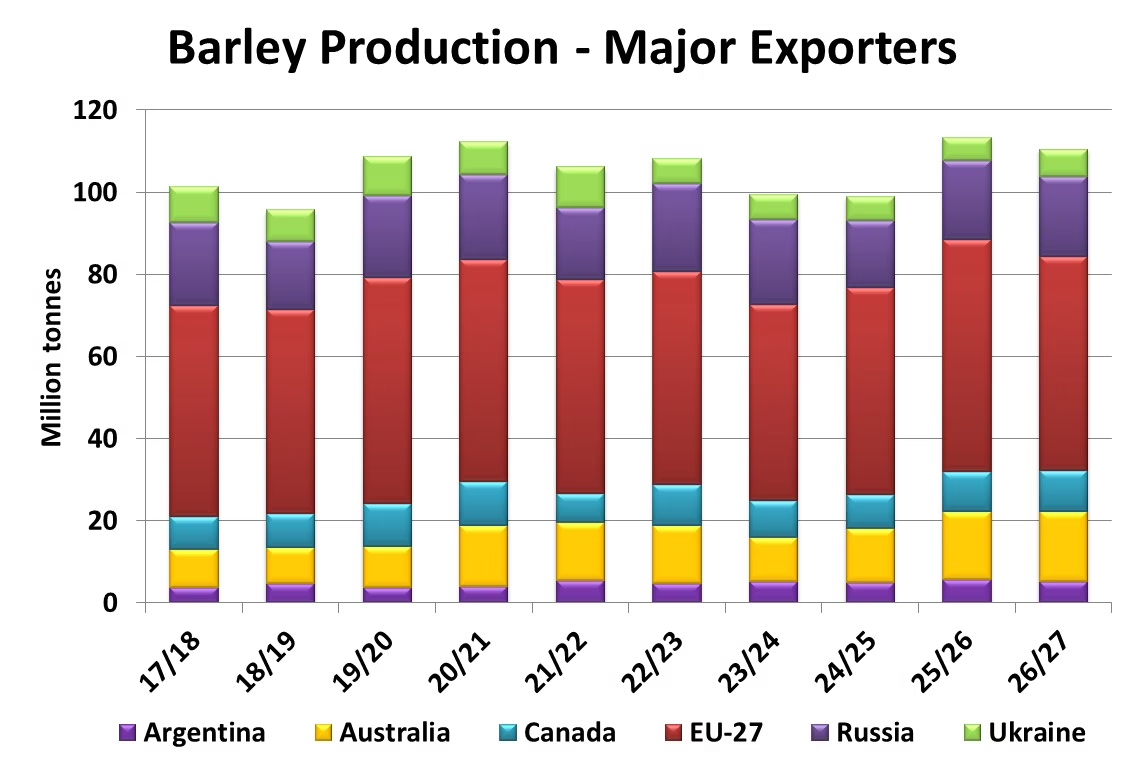
- Major exporters’ 2026/27 production is estimated at just over 110 mln tonnes, but LeftField says available supplies to world markets may be tighter than that total suggests.
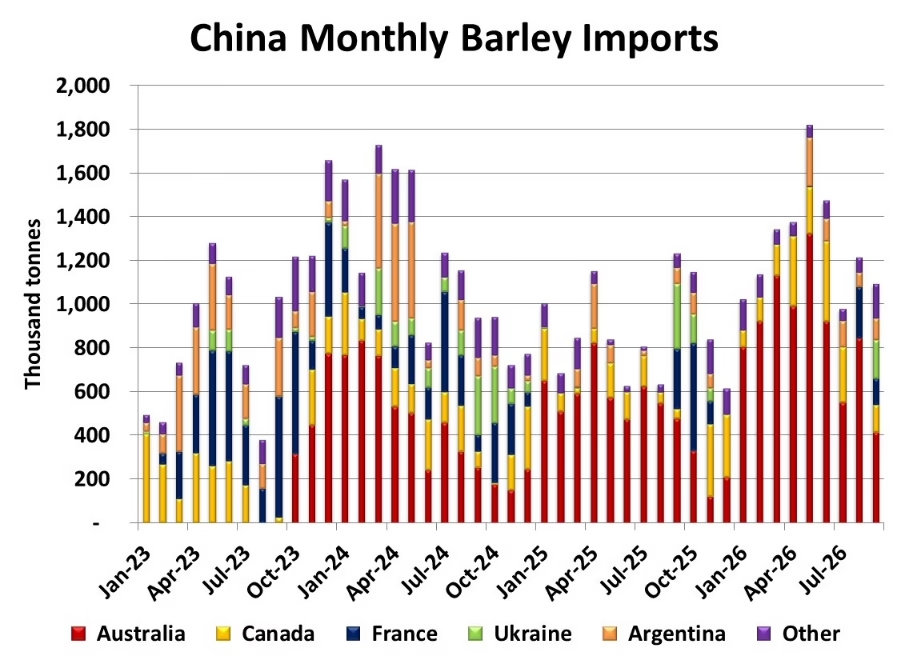
- China is the biggest swing factor for world barley trade. Imports from January through September exceeded 11 mln tonnes, but estimates for 2026/27 vary considerably.
- LeftField expects rangebound world prices: limited downside, and significant rallies aren’t very likely either.
- Canadian exports are expected to be around 2.9 mln tonnes in 2026/27, down from 3.5 mln tonnes last year, due more to smaller supplies than a lack of buying interest.
- Early-season CGC shipments through week 12 were 887,400 tonnes, the third-largest in over 20 years. Prairie barley markets are often quiet in early winter before seasonal strength later in winter and spring.
Canadian Barley Exports Depend on Global Supply and Importer Demand
While domestic livestock feeding is by far the largest source of Canadian barley demand, export movement is important as well. The outlook for Canadian shipments, and how this may impact bids for prairie farmers, is a function of global supplies and importer buying interest, primarily from China.
Exporter Supplies May Be Tighter Than Production Suggests
Combined production across the major exporters is estimated to be down slightly in 2026/27 to just over 110 mln tonnes, still a historically large number. However, available supplies to world markets may be tighter than what is suggested by the production total. Not only is the EU crop smaller, but feed use may increase due to the sharp decline in corn production, reducing exportable barley stocks. Combined Russian and Ukrainian production is estimated to be a little bigger this year, but movement is a problem as long as Black Sea shipping is impaired, with no improvement in immediate sight.
Australia Offsets Part of the Shortfall
Some of the reduced availability from certain suppliers will be offset by Australia. Production estimates continued to increase going into harvest. Early expectations were for a crop of around 14 mln tonnes, but targets have been steadily rising up to 18 mln tonnes or more, which is above last year’s all-time high. This will allow for big exports again in the coming season. Late rain is causing some quality concerns in certain regions, which will be watched closely as the harvest advances, and could have an impact on global malt premiums.
China: The Biggest Swing Factor
China is by far the largest and most important buyer. Total imports from January through September exceeded 11 mln tonnes, only slightly behind the 2024 record, with commitments averaging over 1 mln tonnes per month. Australia is the largest supplier, but Canada sends significant volumes as well. Expectations are for somewhat smaller Chinese imports in 2026/27, partly because tighter exporter supplies limit what is available, and partly because domestic price spreads to other feed grains could trim barley’s import appeal at the margin. China also reportedly harvested a record corn crop, which may dampen import needs. But estimates vary considerably on how much they will ultimately take, which makes them the biggest ‘swing factor’ for world barley trade.
Import Demand Elsewhere Is Quieter
Import demand elsewhere is the quieter part of the story. In aggregate, the Middle East and North African countries often import similar volumes to China. But many of them harvested bigger crops of their own this year, which softens import needs. Japan is also an important market, with volumes expected to stay relatively flat.
World Prices: Rangebound Trade Expected
Global barley prices have been drifting lower recently, although have not corrected to the extent seen in corn and wheat. This reflects a world market that is relatively balanced between tighter exporter supplies in aggregate and somewhat smaller demand. The global corn market is also fairly well balanced. This sets up for rangebound trade, where downside is limited, but significant rallies aren’t very likely either.
Canadian Export Outlook for 2026/27
Expectations are for Canadian exports to be down in 2026/27 to around 2.9 mln tonnes, from last year’s historically large 3.5 mln tonnes, due more to smaller supplies than a lack of buying interest. Early season movement supports this outlook, with CGC shipments through week 12 at 887,400 tonnes, the third-largest in over 20 years, but a bit slower than in 2025/26. Export movement will still be strong, which will result in elevators periodically increasing bids to get coverage for shipping programs. Prairie barley markets are often relatively quiet through the first half of winter prior to seeing some seasonal strength into later winter and spring, a pattern that might be expected again this year.
Market analysis provided by LeftField Commodity Research. November 2026 outlook.
Related Barley Market Reports on BarleyBin.ca
- Barley Market Report: Smaller North American Crops and Low Malt Selection Tighten 2026/27 Supplies – Last month’s look at the supply side, including malt selection.
- Barley Market Report: Tighter Global Supplies Set to Support Canadian Barley Prices in 2026/27 – The August outlook on global supplies and what they mean for Canadian prices.
- Barley Market Report: China Barley Imports Will Shape the Canadian Outlook for 2025/2026 – Earlier LeftField analysis of China’s role in Canadian barley demand.
- Barley Market Report: Exports an Important Part of Barley Price Direction – A past look at how export movement influences barley price direction.
Frequently Asked Questions
LeftField Commodity Research expects Canadian barley exports to fall to around 2.9 mln tonnes in 2026/27, from last year’s historically large 3.5 mln tonnes. LeftField attributes the decline more to smaller supplies than to weak buying interest. Early-season CGC shipments through week 12 were 887,400 tonnes, the third-largest in over 20 years.
According to LeftField, China is by far the largest and most important buyer in world barley trade. Imports from January through September exceeded 11 mln tonnes, and Canada sends significant volumes there. Because estimates of China’s 2026/27 imports vary considerably, LeftField calls China the biggest swing factor for world barley trade.
LeftField says global barley prices have been drifting lower, though not as far as corn and wheat. With exporter supplies tighter but demand somewhat smaller, the world market looks relatively balanced. LeftField expects rangebound trade: downside is limited, but significant rallies aren’t very likely either.
LeftField notes Australian production estimates have risen from early expectations of around 14 mln tonnes to 18 mln tonnes or more, above last year’s all-time high. That should allow big exports again and offset some of the reduced availability from other suppliers. Late rain is causing quality concerns in certain regions, which could affect global malt premiums.
LeftField says prairie barley markets are often relatively quiet through the first half of winter, then see some seasonal strength into later winter and spring, a pattern that might be expected again this year. Strong export movement could also lead elevators to periodically increase bids to get coverage for shipping programs.
About the Author
| LeftField Commodity Research is an independent, data-driven research firm covering Canadian grain, oilseed, pulse, and special crop markets. Founded in 2010 by Chuck Penner, who has nearly 30 years of experience across the Canadian grain industry, and joined by Senior Analyst Jonathon Driedger in 2019, LeftField is based in Winnipeg, Manitoba. Its analysis is built from farmgate-level knowledge through the full value chain, aiming to explain the “whats and whys” behind market moves rather than offer trading calls. |