
Barley Market Report: Canadian Barley Stocks Tighten Ahead of 2026/27 Marketing Year
Estimated reading time: 6 minutes
This barley market report was provided by Leftfield Commodity Research.
Tight Stocks Confirmed as Rain-Delayed Harvest Clouds the 2026/27 Outlook
Saskatchewan barley growers heading into fall 2026 harvest are working against a backdrop of historically tight supplies. StatsCan’s early-September stocks report confirms just how much strong 2025/26 demand ate into what started as the largest barley supply since 2020/21 — and it sets the stage for a 2026/27 marketing year that could still turn on the next few weeks of harvest weather. Here’s what LeftField Commodity Research‘s latest outlook means for malt and feed barley growers heading into the new crop year.
Key Takeaways
- July 31 barley carryout fell to 940,400 tonnes — the lowest in three years and below the 10-year average.
- 2025/26 total usage hit 10.19 mln tonnes, the highest since 2020/21, driven by strong feed demand.
- Canadian barley exports reached 3.50 mln tonnes, the largest in 30 years, led by China, Japan, and a return to Saudi Arabia.
- Tight carryout heading into 2026/27 offers little cushion, with higher acres likely offset by lower yields.
- Rain-delayed harvest raises quality risk that could reshape feed and malt demand forecasts.
In early September StatsCan released their estimate for July 31st barley stocks and an updated supply and disposition table. While reviewing figures for 2025/26 can feel a bit like looking in the rearview mirror at a time when most growers are planning ahead for sales, it can help in understanding the setup going into harvest and how that might impact the market in 2026/27.
StatsCan Reports Lowest July 31 Barley Carryout in Three Years
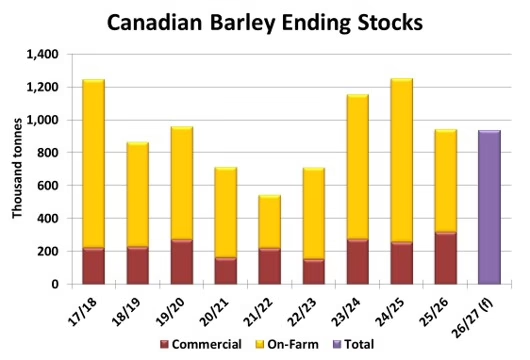
StatsCan reported July 31st stocks (which is the 2025/26 carryout) at 940,400 tonnes, the lowest in three years, and lower than the 10-year average of 1.1 mln tonnes. Commercial stocks were shown at 315,600 tonnes, the highest since 2016/17, and reflects inventory being accumulated prior to good export movement in the first few weeks of August. This put on-farm stocks at 624,800 tonnes, on the low end of recent years.
Record Supply Met Record Demand in 2025/26
While the July 31st stocks number wasn’t notably low, it’s important to remember the 2025/26 season started with the largest barley supply since 2020/21 after seeing record yields last summer. In other words, expectations at this time last year were for barley stocks to likely be quite heavy prior to the 2026 harvest. The fact they came in at under 1.0 mln tonnes reflects strong demand last year, something StatsCan also reported.
Total Barley Usage Hits Highest Level Since 2020/21
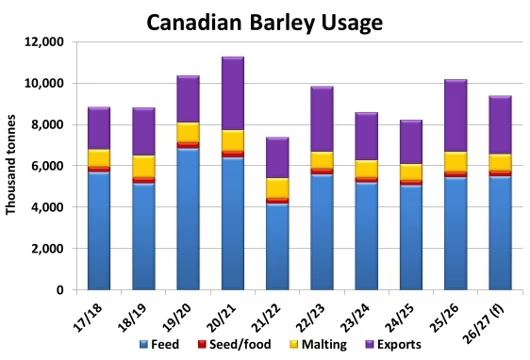
StatsCan showed total barley usage in 2025/26 at 10.19 mln tonnes, the highest since 2020/21. Feeding made up a little over half of that, at an estimated 5.47 mln tonnes, the most in three seasons. While the FWD category can act as a bit of a ‘catch all’ to help balance the rest of the numbers in the table, feed barley was more competitively priced than corn into the key southern Alberta market through a good portion of the crop year, which encouraged demand.
Canadian Barley Exports Post Best Season in 30 Years
Canadian barley exports were also strong last season at 3.50 mln tonnes, essentially on par with 2020/21 as the largest in 30 years, helped by Canadian barley being competitive on global markets. China was the largest destination at 2.15 mln tonnes, while volumes to Japan were up sharply. Saudi Arabia was also a notable buyer at 171,720 tonnes, the first Canadian shipments to them in a decade. Malt barley use tends to not fluctuate a great deal from one year to the next.
What Tight Carryout Means for 2026/27
The big supply-big demand season in 2025/26 means there wasn’t a large cushion coming into the current marketing year. Canadian barley acres are higher but it’s likely yields will end up below the 2025 record, which points to a smaller crop. This sets up early expectations that total usage will need to be reduced in 2026/27, and again leaving a relatively tight carryout. Rising prices for wheat, corn and other grains globally also underpins the Canadian barley outlook.
Harvest Delays Add Uncertainty to the Outlook
However, the slow and rain-delayed prairie harvest creates uncertainty on how the coming year will play out. Initial expectations were for feed consumption to be similar to this past year, while tighter supplies would force some rationing of exports. But the potential quality impact on the sizeable amount of barley and other cereals still in the field could change things. It remains to be seen how much barley will make malting grade, or if export potential is impacted by the quality profile. Larger supplies of lower grade wheat and other cereals could add to competition in domestic feed grain markets. Whether this will happen on a scale that changes demand forecasts and the outlook for feed and malt barley prices could be affected by western Canadian weather over the next couple of weeks.
Related Barley Market Reports on BarleyBin.ca
- Barley Market Report: Tighter Global Supplies Set to Support Canadian Barley Prices in 2026/27 (August 2026)
- Barley Market Report: Strong Demand Pulls Down Canadian Barley Ending Stocks in 2025/26 (June 2026)
- Barley Market Report: USDA and StatsCan Update 2026 Barley Acreage Estimates (July 2026)
- Barley Market Report: Largest December 31st Canadian Barley Stocks Since 2019 (March 2026)
Frequently Asked Questions
StatsCan reported July 31, 2026 barley stocks — the official 2025/26 carryout — at 940,400 tonnes. That’s the lowest level in three years and below the 10-year average of 1.1 million tonnes, split between 315,600 tonnes in commercial positions and 624,800 tonnes held on-farm.
The 2025/26 season opened with the largest barley supply since 2020/21 thanks to record yields, but strong demand used most of it up. StatsCan reported total usage at 10.19 million tonnes, the highest since 2020/21, which left a tighter-than-expected carryout despite the big crop.
Canadian barley exports reached 3.50 million tonnes last season, tied with 2020/21 as the largest in 30 years. China was the top destination at 2.15 million tonnes, Japan’s volumes rose sharply, and Saudi Arabia bought 171,720 tonnes — its first Canadian barley purchase in a decade.
Higher 2026 barley acres are likely to be offset by yields below last year’s record, pointing to a smaller crop and another tight carryout. Rising global prices for wheat, corn, and other grains are also supporting the Canadian barley outlook heading into 2026/27.
The slow, rain-delayed prairie harvest has created real uncertainty. Quality outcomes for the barley still in the field will determine how much makes malting grade versus feed grade, which could shift both export potential and domestic feed demand over the coming weeks.
About LeftField Commodity Research
| LeftField Commodity Research is an independent, data-driven research firm covering Canadian grain, oilseed, pulse, and special crop markets. Founded in 2010 by Chuck Penner — who has nearly 30 years of experience across the Canadian grain industry — and joined by Senior Analyst Jonathon Driedger in 2019, LeftField is based in Winnipeg, Manitoba. Its analysis is built from farmgate-level knowledge through the full value chain, aiming to explain the “whats and whys” behind market moves rather than offer trading calls. |