
Barley Market Report: USDA and StatsCan Update 2026 Barley Acreage Estimates
This barley market report was provided by Leftfield Commodity Research.
Estimated reading time: 4 minutes
Key Takeaways
- StatsCan raised its 2026 Canadian barley acreage estimate to 6.70 million acres, up from the initial 6.44 million-acre estimate.
- Even with larger seeded area, Canadian barley production could fall if yields return closer to normal after last year’s record performance.
- US barley acreage remains historically low despite a modest USDA increase, keeping crop size sensitive to yield outcomes.
- US corn acreage stayed largely unchanged from March, supporting expectations for a smaller 2026 corn crop than last year.
- Weather across Western Canada and the United States is now the key factor for North American yield potential and the longer-term price outlook.
Updated acreage reports draw added market attention
On June 30th both StatsCan and USDA provided updated estimates for 2026 seeded area. StatsCan’s initial figures were released in early March and based on a farmer survey in December. Changing market conditions between the initial survey and prairie planting, as well as delayed seeding in parts of western Canada, meant significant changes to the acreage breakdown between the different crops was expected. USDA’s first survey-based estimates were shown on March 30th, and while that data was collected only a few weeks prior to the report coming out, the initial impact of the US-Iran war on fertilizer prices had analysts wondering if US farmers might have made some last second acreage changes. As a result, these reports were met with a little more anticipation than in other years.
Canadian barley acres rise from early expectations
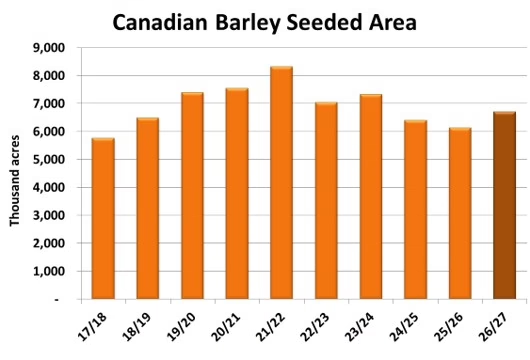
StatsCan bumped up the barley acreage estimate to 6.70 mln, from 6.44 mln initially and 9% higher than 2025. This is the largest barley area since 2023, although still below some pre-report guesses and compared to the 5-year average of just over 7.00 mln acres. It’s possible the final acreage total could be a bit different as very wet conditions in parts of the prairies may have forced a few very late planting changes after the survey was done. In the case of barley, some potential area could have been lost as certain fields went unseeded, although it’s also possible barley gained a bit of ground if farmers shifted away from crops with a longer growing season. StatsCan will update their acreage number in the December report.
Production outlook depends on yield normalization
Even with higher seeded area, Canadian barley production will likely be lower in 2026 if yields don’t match last year’s record performance. A 65.0 bu/acre yield, which is the 5-year olympic average, results in a crop size of around 8.60 mln tonnes, 12% smaller than in 2025, and would force reduced exports and feed use. In this sense, the larger seeded area on its own isn’t necessarily negative to the Canadian barley price outlook.
US barley acreage remains historically low
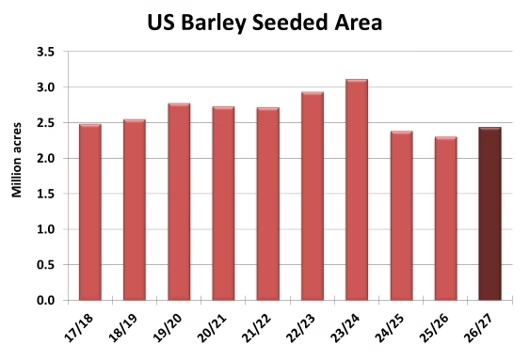
USDA’s barley acreage adjustment was relatively modest, nudging US area up to 2.43 mln, from 2.35 mln previously, and 6% more than last year. Even so, that is still a historically low figure, with the 5-year average at closer to 2.70 mln acres. If yields slip closer to normal levels from the 2025 record, the US barley crop would be the smallest since the drought year of 2021/22.
US corn acreage keeps feed grain markets weather-sensitive
USDA showed US corn area at 95.3 mln acres, essentially unchanged from March, and down from last year’s massive 98.8 mln acres. Some were expecting a smaller number, but the good early pace of planting encouraged the corn go to in, while the effect of the war-driven spike in fertilizer prices didn’t seem to have a big impact on farmers’ decisions in the short-term. This will result in a smaller US corn crop in 2026.
Growing conditions become the next market focus
With the acreage questions (mostly) settled, attention will now focus more intently on growing conditions throughout the balance of the summer. The early outlook is mixed in western Canada given the excessive rain through some regions, while other areas are favorable. Early season US conditions have been mostly non-threatening, but the most important weather is still ahead. The next couple of weeks will be critical in determining North American yield potential and the longer-term price outlook.
Find more barley market reports here:
- Barley Market Report: Canadian Barley Stocks Tighten Ahead of 2026/27 Marketing Year
- Barley Market Report: Tighter Global Supplies Set to Support Canadian Barley Prices in 2026/27
- Barley Market Report: USDA and StatsCan Update 2026 Barley Acreage Estimates
- Barley Market Report: Strong Demand Pulls Down Canadian Barley Ending Stocks in 2025/26
- Barley Market Report: Early Guesses for 2026 Canadian Barley Production