
Barley Market Report: Early Guesses for 2026 Canadian Barley Production
This barley market report was provided by Leftfield Commodity Research.
Key Takeaways
- Seeded acres are still uncertain: StatsCan’s early estimate is 6.4 million acres, but updated numbers (June 30) and spring price signals could shift expectations.
- A return from 2025’s record yield could reduce total output even if acres rise—tightening the 2026/27 Canadian barley balance sheet.
- Late spring conditions and relative new-crop pricing could pull additional barley area, especially if seeding pace becomes a concern.
- Early global outlooks (e.g., IGC) point to lower 2026/27 world barley production versus last year, mainly on softer yields.
- If global production lags demand again, ending stocks could tighten and put more focus on weather risk in key regions.
- Prices may be supported by a tighter grain complex, but feed substitution can cap rallies unless other feed grains are also constrained.
Barley Acres in Canada (StatsCan): Implications for 2026 Canadian Barley Production
Even though the growing season is in its earliest stages and the most important weather is still ahead, it’s not too soon to be projecting 2026 production scenarios and the potential impacts on markets. StatsCan’s initial barley planting estimate was 6.4 mln acres, up 4.9% from last year but below the 5-year average of 7.0 mln acres. However, it’s widely believed prairie plantings will be larger than what StatsCan showed, as the survey was done in mid-winter and barley prices have been trending higher since then (StatsCan will provide an updated acreage estimate on June 30th).
Barley Yield Forecast and Production Scenarios
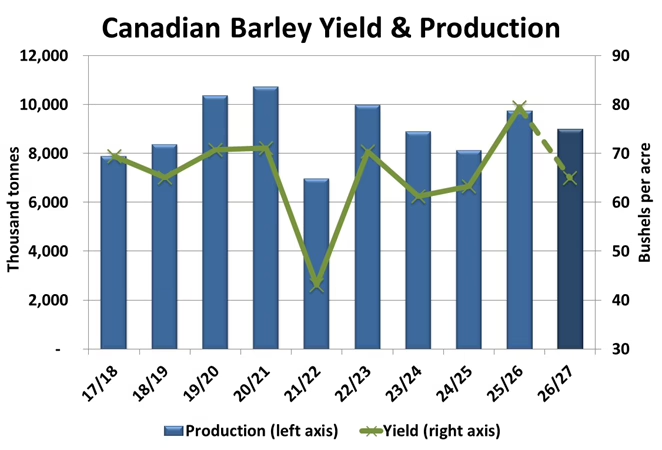
Even with higher acres, Canadian barley production could be smaller if yields come down from the 2025 record of 79.4 bu/acre. For example, if acres end up increasing to the longer-term average near 7.0 mln, but yields return to more typical levels, production would decline to 9.0 mln tonnes, from 9.7 mln last year. This sets up for a tighter Canadian barley market in 2026/27, particularly if export demand remains strong and production of other cereals is also lower, which limits the supply of prairie feed grains.
Seeding Progress and Late Spring
It’s possible the late prairie spring ends up drawing in even more barley acres than what some analysts are currently projecting, as this has allowed a wider window for farmers to make last minute changes at the same time new-crop barley values have been relatively stronger than some other crops. And while it’s still too early to assume seeding will get worryingly delayed, barley’s shorter growing season could result in a little more area being pulled in if progress doesn’t start to get some momentum in the near future.
World Barley Production (IGC Outlook) and Why It Matters
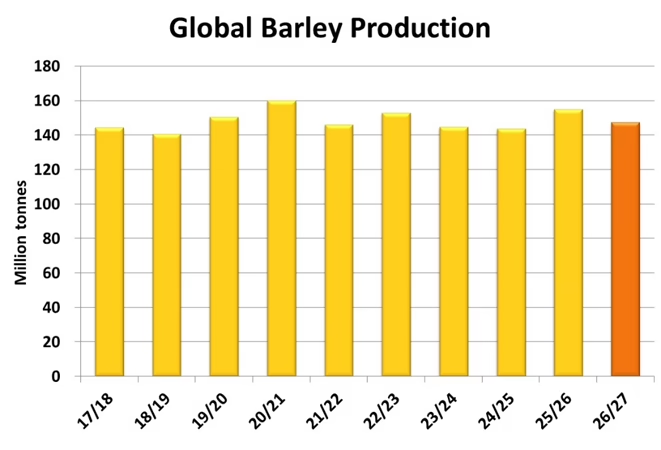
Early indications suggest world barley production could dip in 2026/27 as well. The latest IGC report put the coming year’s crop at 147.1 mln tonnes, down 7.7 mln (5%) from last season, and near the 10-year average. The assumption is that seeded area remains roughly unchanged, but that yields will decline from 2025’s unusually high level (it’s worth noting that last year saw strong yields not just in Canada, but across nearly every other key growing region as well).
Global Barley Demand, Ending Stocks, and Weather Risk
There is a good chance global acres end up increasing in 2026, rather than stay flat, as farmers in those regions that plant spring barley respond to improving prices. This means there could be some upside to the initial projections. Even so, this will likely still see production lag demand, which has been trending higher over the past 5 years. This sets up for lower supplies and tighter ending stocks at the end of 2026/27, with little room for any significant yield threats. Traders will be closely watching weather conditions across the major production areas, including the EU, Canada, the Black Sea region, Australia and Argentina.
Barley Price Outlook: Feed Demand, Substitution, and 2026/27 Market Direction
On its own, lower production doesn’t automatically mean stronger prices as most barley is consumed by livestock, leaving the potential for substitution with different feed grains if values climb higher. However, early indications suggest world production of corn, wheat and other grains could be a bit lower as well this season. If so, that sets up for a tighter grain complex in general, which is a supportive influence for barley values. But yields will ultimately be the biggest driver of that, both in Canada and globally.
Find more barley market reports here:
- Barley Market Report: Canadian Barley Stocks Tighten Ahead of 2026/27 Marketing Year
- Barley Market Report: Tighter Global Supplies Set to Support Canadian Barley Prices in 2026/27
- Barley Market Report: USDA and StatsCan Update 2026 Barley Acreage Estimates
- Barley Market Report: Strong Demand Pulls Down Canadian Barley Ending Stocks in 2025/26
- Barley Market Report: Early Guesses for 2026 Canadian Barley Production