PAMI Answers 8 Common Questions About Grain Drying and Storage
During a challenging harvest season plagued by cold and damp conditions across the Prairies (2019), PAMI and MARD fielded numerous calls from producers and helped them work through various engineering concerns related to grain storage and drying under these circumstances.
The following is a summary of frequently asked questions and guidance on where to look for reference material on the topic.
Answers to 8 FAQ’s About Grain Drying and Storage
You can find reference equilibrium moisture content (EMC) charts and guidance on how to interpret them along with a how-to guide for measuring your airflow rate here:
Equilibrium Moisture Content Charts and Information
Measuring and Estimating Airflow Rates from Fans
This information will help you decide how big of a fan you need and when to turn on your fans.
More information from PAMI on natural air grain dying and supplemental heating can be found here:
Blowing a Lot of Hot Air: Basics of Bin Management
Comprehensive Natural-Air-Grain-Drying (NAD) Factsheet
FAQ for Supplemental Heating
EQUILIBRIUM MOISTURE CONTENT (EMC) CHART FOR BARLEY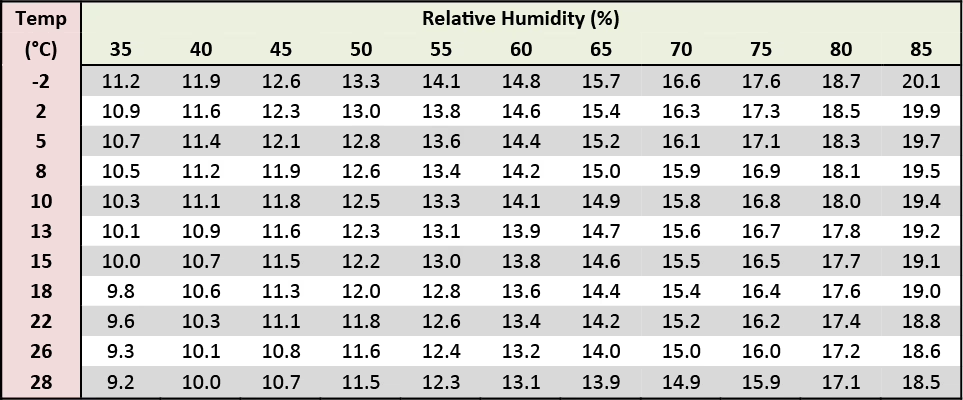
Start by referencing the commodity-specific EMC charts. These charts indicate when the ambient air conditions will have the capacity to dry the grain. The fans should be left running if the EMC is less than or equal to the current grain moisture content. If this is not the case, try implementing a supplemental heating system; relative humidity of the inlet air is cut in half with a 10 C increase so a bad drying day can be turned into a good one. Make sure that the heater system is safe to operate in rainy condition however. If added heat is not an option, carefully monitor the conditions in the bin and you may have to dry the grain in a heated-air dryer if prolonged damp conditions persist.
Fans should be run a minimum of 24 hours to cool grain as soon as the first load is added to the bin. If you are managing natural air drying (with or without heat), you should be consulting your EMC charts to determine when the inlet air is suitable for drying. Once you start drying, it is not recommended to shut off the fans until the grain is dry so that moisture does not settle in the middle of the grain bulk; an exception would be during times of prolonged unfavorable ambient conditions where there is a risk of moisture addition. Careful monitoring (or any monitoring) would then need to be used to determine if the grain is still safe to store or if it should be dried in a heated-air dryer.
Green or immature grain kernels can be a higher moisture content than mature seed and transfer that moisture to surrounding dry grain. Green kernels can also continue to respire for several days after harvest. Aeration fans (low airflow rates; 0.1 cfm/bu) should be turned on for a minimum of 4 days to condition the grain if there are a significant number of greens. Monitoring of the grain conditions over 2-4 weeks is also recommended in order to catch any possibility of hot spots due to respiration of those green kernels; aeration can be resumed if these spots start to develop. Regular NAD management principles can be used if the majority of the grain is tough. 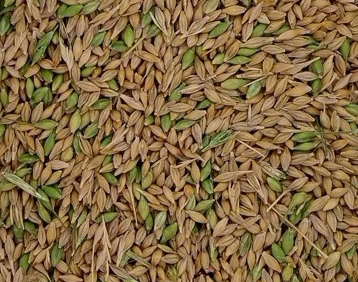
Natural air-drying rates can be around 1 to 2% per week if ambient (or inlet in the case of supplemental heating) temperatures are above 10°C, relative humidity is below 60%, and a minimum of 1 cfm/bu of airflow is maintained. Monitoring, using grain moisture cables (or other systems), is the best way to know the grain is dry. When using supplemental heat, the grain is likely to be over-dry at the bottom once the average moisture content in the bin is considered dry. Mixing is recommended to even out the moisture profile.
A: This information is lacking, so PAMI is currently working to benchmark the efficiency and energy consumption of different supplemental heat systems. Find the results of this study here. In the meantime, there are different methods of adding supplemental heat to choose from:
– Direct: Combustion flame is directly used to heat air.
– Indirect: Fuel is used to heat water then passed through heat exchanger(s).
– Upstream: Heater is installed upstream of aeration fan; easier to implement or transfer between bins, but fan is exposed to fan.
– Downstream: Heater is installed downstream of aeration fan; likely more energy efficient, but not easily transferred between bins.
– Fuel options: electricity, natural gas, propane, diesel
More info specific to supplemental heat (sizing heaters, etc…) is available as a factsheet on PAMI’s website:
FAQ for Supplemental Heating
Measuring and Estimating Airflow Rates from Fans
Use only CSA certified heaters.
When drying grain in bin, especially when using supplemental heat, the air at the top of grain bulk will be warm and moist. Condensation can occur when that air hits a cold roof and that moisture may drip down the walls causing localized clumping or frozen grain if ambient conditions are sub-zero. The recommendation is to ensure adequate ventilation (1 ft² per 1000 cfm) at the bin roof to allow the moist air to exit the bin; this can be via passive or active ventilation. Raising the roof slightly is another option that will result in any condensation dripping outside the bin rather than into the grain.
Read more:
Comprehensive Natural-Air-Grain-Drying (NAD) Factsheet
FAQ for Supplemental Heating
If ambient conditions are cool and dry, tough or damp grain could be stored for around 1 week while waiting for dryer capacity; however, aeration fans should be used to condition the grain to prevent hot spots forming due to the moisture. Monitoring (moisture or temperature cables) are always recommended.
More resources available at pami.ca/agricultural-research:
- Comprehensive Natural-Air-Grain-Drying (NAD) Factsheet
- Blowing a Lot of Hot Air: Basics of Bin Management
- Equilibrium Moisture Content Charts Grain Storage
- Measuring and Estimating Airflow Rates from Fans
- FAQ for Supplemental Heating
- Grain Storage and Drying FAQ
- Improved Management of Stored Pulses
Prairie Agricultural Machinery Institute
PAMI is a Canadian organization established in 1975 that focuses on research, innovation, and testing in agriculture, as well as other industries like mining and transportation. PAMI provides practical solutions through machine design, testing, and process development. Their expertise supports the advancement of sustainable farming practices and technological innovation in agriculture, helping producers improve profitability and efficiency.

About this Resource:
This extension work was conducted by PAMI on behalf of Manitoba Agriculture and Resource Development (MARD) thanks to funding from the Canadian Agricultural Partnership. It was originally published in 2020 on PAMI’s website.