Three Decades Fighting Barley Disease: The Legacy of Pathologist Kelly Turkington
Delaney Seiferling, Freelance Writer
Industry celebrates barley pathologist who helped Prairie farmers stay ahead of disease
The Western Canadian barley industry is bidding farewell to one of its leading experts in barley disease pathology.
Dr. Kelly Turkington will leave his role as a research scientist and pathologist at Agriculture and Agri-Food Canada’s Lacombe Research Centre this spring after his position was eliminated as part of a round of mass layoffs that reduced scientific capacity, reorganized several research programs and stunned the agriculture industry.
Beyond the broader impact on the agriculture sector, Turkington’s departure will be felt deeply within the barley industry. His work over the last 30 years has transformed how barley diseases are understood and managed in Western Canada, shaping everything from fungicide recommendations to variety development and integrated crop management practices.
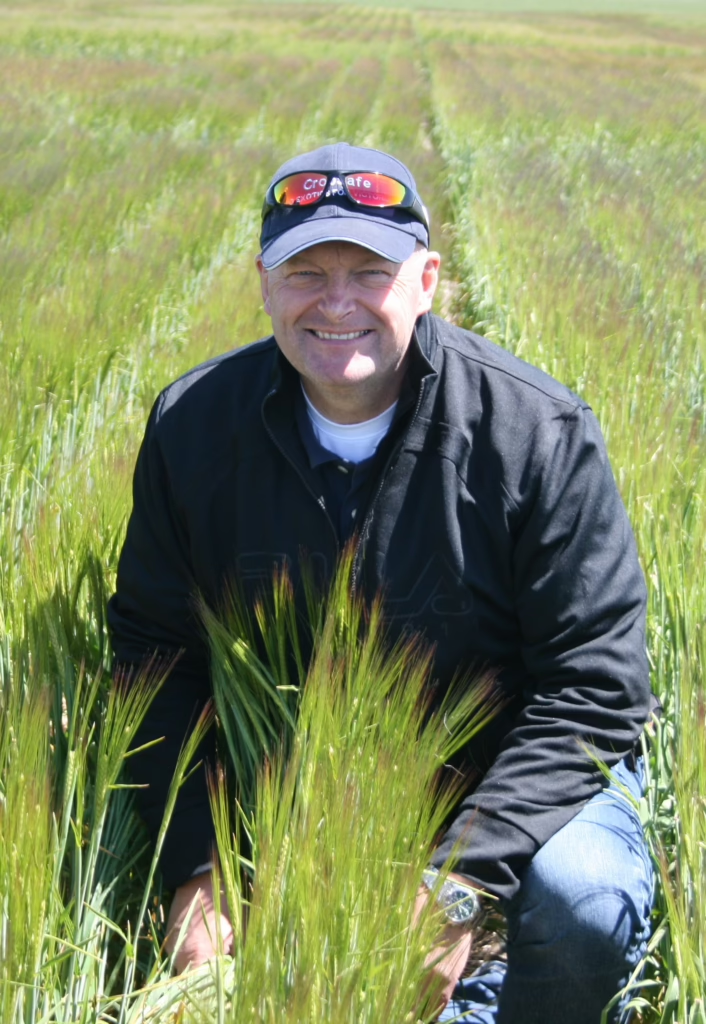
Looking back over his career, he says he’s grateful for the opportunities he was given to impact the industry.
“We’ve been able to address a lot of concerns over the last 30 years,” he says, adding one of the aspects of the job he most enjoyed was collaborating with farmers.
“That flow of information from the field level through the farmers has been critical over the years for us. We’ve learned as much as we’ve passed on to producers, and hopefully what we’ve passed on has been useful.
He says another highlight of the job has been collaborating with fellow researchers, technical staff, crop consultants and other industry members.
“For me, the most valuable part of the work has been that interaction,” he says. “I can’t emphasize that enough. It definitely hasn’t been a one‑person show.”
As the industry bids goodbye to a trusted and valued partner in the fight against barley disease, here’s a look at some of the most noteworthy changes that have come from the work of Turkington and his colleagues over the last 30 years in terms of barley disease management.
Understanding the Benefits of Direct Seeding
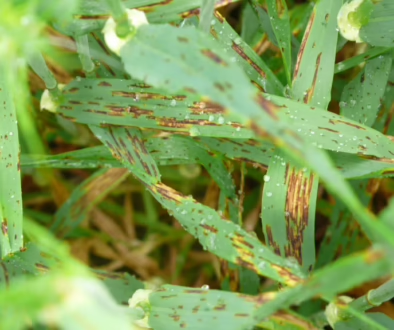
Early in his career, Turkington’s work focused on the major leaf diseases affecting prairie barley, including scald, net form net blotch and spot form net blotch. Working closely with breeding programs, his team conducted large-scale screening nurseries to identify resistance and support the development of improved varieties.
But perhaps the biggest shift during the 1990s and early 2000s was the industry’s transition to conservation tillage and direct seeding. Turkington and colleagues examined how these changes would affect disease pressure and crop productivity.
One key finding surprised many at the time: direct seeding reduced common root rot severity, likely due to a more active and diverse soil microbial community that suppressed the pathogen.
“We did some work looking at common root rot and barley and the impact on tillage and it was quite interesting in that direct seeding was actually a beneficial practice,” he says.
“It reduced the severity of common root rot in barley. We attributed that to a more vibrant microbial environment in the soil under a direct seeding system, and that had a negative impact on the common root rot pathogen.”
That work helped build confidence in direct seeding as both an environmental and disease-management tool – the adoption of which has had widespread impacts. Today, no-till or direct seeding is used on roughly 70 to 80 per cent of cropland in Western Canada, according to Agriculture and Agri-Food Canada and Statistics Canada. This shift has also reduced soil erosion, improved soil organic carbon and helped cut fuel use and greenhouse gas emissions, making conservation seeding one of the region’s most significant environmental success stories.
Managing Fusarium Head Blight in Barley
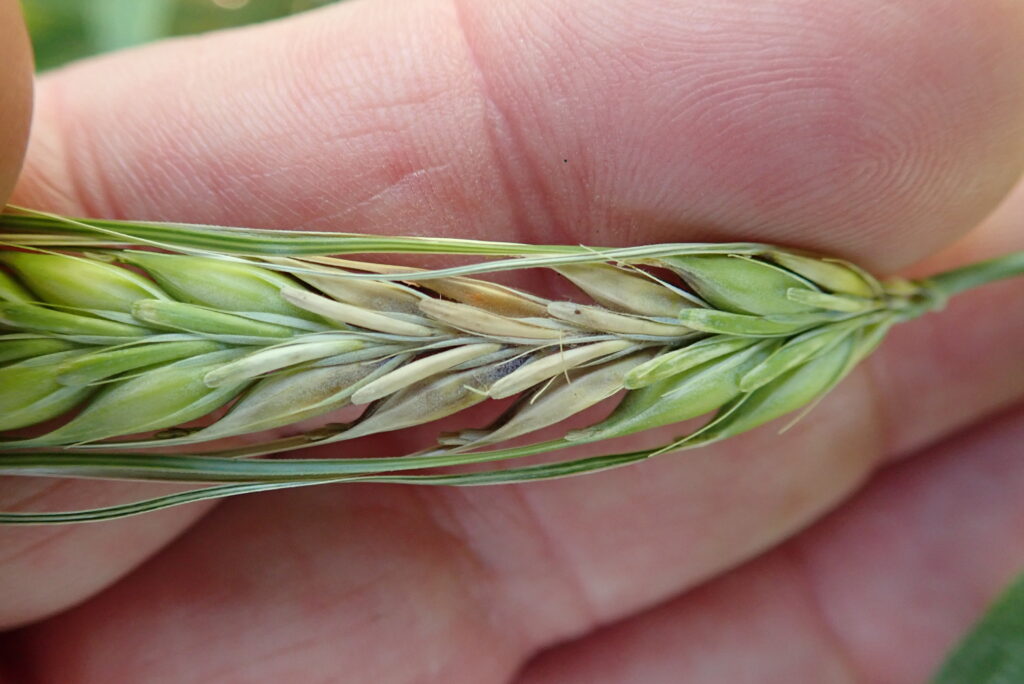
While Fusarium Head Blight (FHB) was once relatively limited in Western Canada, Turkington and collaborators began monitoring for the pathogen in the late 1990s as the disease intensified in Manitoba and eastern Saskatchewan.
As it spread westward, the implications for malt barley became clear. The disease not only affected yield but also grain quality through the production of deoxynivalenol (DON), a mycotoxin unacceptable to maltsters and brewers.
“In barley, there’s a couple of main issues. First of all, Deoxynivalenol … the main mycotoxin that Fusarium graminearum produces, is not something that the maltsters want to see. Brewers are very, very cautious about that issue.”
This emerging threat shifted research priorities toward understanding how management practices — particularly fungicide timing — could reduce both disease and DON risk.
Refining Fungicide Strategies for Disease Management
A great deal of Turkington and his colleagues’ work focused on refining fungicide strategies for managing disease in barley in Western Canada, and not just FHB.
Their research on this topic, over the last several decades, has contributed to several findings that have informed on-farm practices and impacted farmers’ profits and yields, including expanding the FHB spray window.
While earlier recommendations suggested a narrow application window around head emergence, more recent research from Canada and the U.S. showed the effective window is wider than previously thought, giving farmers more flexibility when weather or logistics delay spraying.
Turkington was also involved in research evaluating the common practice of adding a reduced-rate fungicide to herbicide applications early in the season.
“It was cheaper product to put a half rate in with our herbicide and the assumption was that that was going to hold off disease,” he says.
Results, however, showed this approach did not provide meaningful disease control and that, instead, the most effective timing is from flag leaf through shortly after head emergence, when protecting the upper canopy had the greatest impact on yield and quality.
Again, this knowledge has widely informed on-farm practices for Western Canadian barley farmers.
Finally, Turkington’s research over the years has also supported the idea that a single, well-timed fungicide application later in the season can control both leaf diseases and FHB while also reducing the risk of fungicide resistance.
Turkington’s research over the years has also supported the idea that a single, well-timed fungicide application later in the season can control both leaf diseases and FHB while also reducing the risk of fungicide resistance.
“If we look at the big picture in terms of fungicides, if we try to reduce our risk as much as possible so that we only have one single application post head emergence, that gives us the dual benefit of suppression of Fusarium head blight and DON,” he says. “It also protects those upper canopy leaves in terms of negative effects from scald and the two types of net blotch and spot blotch.”
Understanding the Benefits of Integrated Management
Since he began his career in the early 90s, Turkington has been interested in learning and understanding the benefits of an integrated management approach for barley farmers.
“I’ve been able to look at barley disease management from a broad range of perspectives… from the breeding process and developing resistant varieties, looking at barley production and management of yield, quality and pest management,” he says.
He believes his work in this area has reinforced the benefits of an integrated approach to barley disease management and shown that the most effective disease control comes from combining less susceptible varieties, crop rotations, targeted fungicide timing and appropriate seeding practices.
In light of all this, he believes farmers should view it as a foundational strategy in their disease management strategies.
Threats and Opportunities Going Forward
Over Turkington’s career, the disease landscape has continued to evolve. Research has documented increasing variation in net blotch populations and early signs of fungicide resistance to commonly used products. More recently, Turkington’s team has shifted screening efforts toward emerging concerns such as bacterial leaf streak.
At the same time, climate variability and changing production practices are influencing which diseases dominate in a given year, reinforcing the need for ongoing monitoring and adaptive management.
Looking ahead, one area Turkington believes deserves more attention is root health.
“It’s more of a challenge I would say, as it’s out of sight, out of mind,” he says, adding that because root diseases are harder to see and measure, their impact is often underestimated, even though they influence water and nutrient use efficiency.
He also hopes that barley disease research in western Canada will continue to lean more into collaboration – which has been such a cornerstone of his career – between not only scientists and farmers but also between traditional field skills and new molecular tools.
For him, the most promising path forward is one where researchers stay close to the field while embracing what genomics can offer.
“I think we need to recognize the importance of a combination of approaches, he says. “Marrying the two together and not maybe focusing one at the expense of the other, I think is important.”
Want more from the BarleyBin?
This is article is featured in the Spring 2026 edition of the BarleyBin Magazine.
Or, look for Season 3 of The BarleyBin Podcast this May, wherever you get your podcasts. We’re diving deeper into the history of disease research on the Prairies.