Efficient Barley Processing: New Research Boosts Feedlot Profits
New research tackles a costly problem for cattle feeders, offering practical strategies to process mixed barley kernels and boost feed efficiency and profits.
By Geoff Geddes, Freelance Writer
Variety may be the spice of life, but for barley growers and cattle producers, varying kernel size can spell trouble. The differing dimensions often wreak havoc when processing kernels, and that spells trouble for producer profits. Finding a better way is what research is all about, and that was the goal of the project “Processing Barley Grain of Variable Kernel Size”. For SaskBarley, funders of the project, it’s another chance to invest levy dollars to solve research problems affecting feed barley and maximize the benefits to ensure feed barley is well utilized.
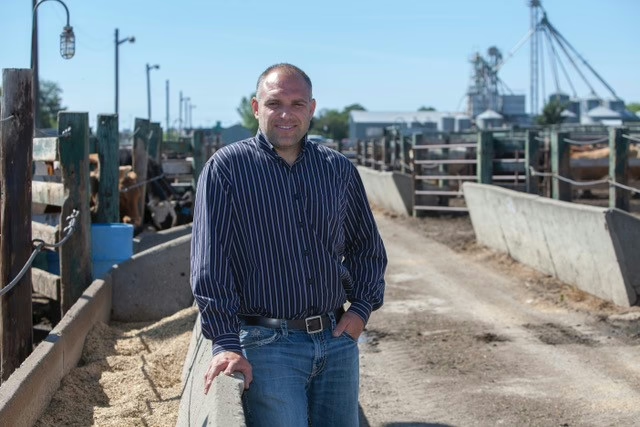
“In Western Canada, producers are growing different cultivars on different lands under various environmental conditions,” says Dr. Gregory Penner. Dr. Penner is a professor in the Department of Animal and Poultry Science, College of Agriculture and Bioresources at the University of Saskatchewan. “This results in a wide range of bushel weights and kernel dimensions, especially with feed grain barley.”
So? Can’t the kernels just be separated by size? In ag, it’s never that simple.
“Feedlots are buying multiple Super Bs of barley on a daily basis, so there’s just no capacity to segregate it based on source. As a consequence, barley with plump kernels and smaller kernels are blended together.”
Learn more: Feeding Barley Grain to Beef Cattle
One Size Doesn’t Fit All
When barley is processed, producers adjust the roller gap and input speed based on kernel size. Faced with a variety of sizes, they must make a choice: Choose the setting for small kernels and overprocess the larger ones, or target bigger kernels and under process the tinier ones. The latter case means a costly loss of opportunity for farmers, as the poorly processed barley passes through cattle undigested. This is clearly detrimental to farmers who have paid for feed that will offer no nutritional benefit to their herd.
“With this study, we hope to address that commercial reality and examine different means to avoid over or under processing.”
To that end, researchers produced barley grain with an array of kernel sizes, including both light and heavy weights. By blending the kernels, they created challenging samples to analyze and tested a number of approaches to processing them.
One such method was dry rolling, the simplest technique used by beef cattle producers. Scientists also employed tempering, where moisture was added to the barley in two different amounts: 10 per cent moisture and 35 per cent moisture. With both amounts, the barley was then left to sit for 12-24 hours before being processed.
“We also evaluated steam flaking, where steam is used to provide a bit of moisture. The grain is then passed through a flaker mill and cooled, creating a stable kernel for processing.”
Learn more: Maximizing Cattle Performance with Barley Feed
Outcomes and Insights
The results of these tests offered insights for both barley growers and cattle producers.
Watch the webinar where Dr. Greg Penner showcases some of these outcomes with tips for more efficient processing: Barley Isn’t Corn: How to Process It for Maximum Feed Efficiency
“Using reconstituted, high moisture barley, we found that we can effectively swell the kernels and process that barley more consistently. To achieve that result, you must process the barley more severely than with dry rolling to attain the same level of digestibility.”
That finding alters the standards for processing with this method. It also presents some logistical challenges, as the wet product doesn’t flow as smoothly as dry kernels.
“For large producers, it would be hard to implement a reconstituted, high moisture processing system. This approach is geared more for small producers, ideally those that are harvesting high moisture barley.”
Scientists also saw interesting results with tempering and steam flaking compared to dry rolling.
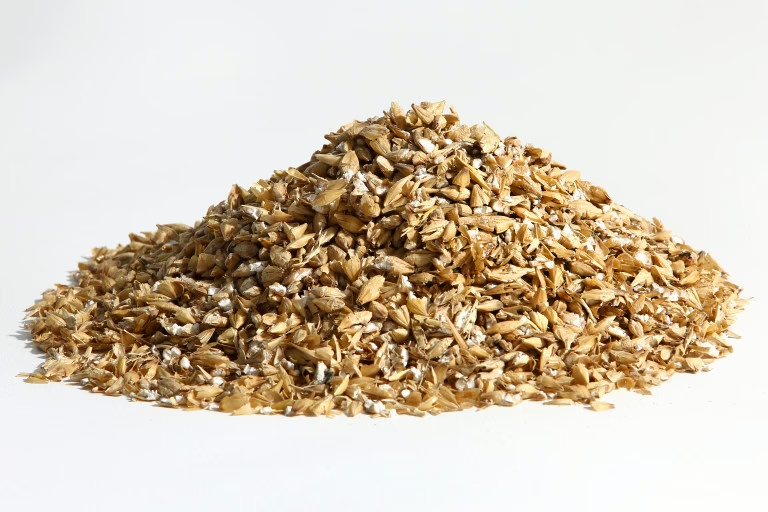
“When we temper or steam flake, we can reduce the production of fine particles during processing. As a result, we yield a more consistent product and reduce the risk of over processing.”
Learn more about target flaking densities when steam rolling barley vs. corn.
Of note, steam flaking did not lower cattle feed intake, and there was evidence that it may even improve growth performance relative to dry rolling.
For producers who use dry rolling, the study addressed a common concern whereby cattle may sort fine kernels out of their diet.
“By adding water to the ration during mixing, it helped bind the small and large particles in the diet. In this way, we prevented cattle from segregating the smaller kernels and reduced variance in marbling percentage [a key factor in determining the quality grade of beef] for finishing cattle.”
This suggests that cattle producers may be able to reduce the variation of cattle in a pen, as the animals will eat a more consistent diet.
“If you’re at a dinner buffet where everyone loves steak, and your table goes last, you might not get the best cut by the time it’s your turn. Similarly, when penned cattle only consume part of their diet, the cattle coming later won’t have access to the same ingredients.”
With any ag research project, success is measured by how it impacts producers, and this study checks that box.
“We have helped highlight that processing strategies may be applied to deal with small barley kernels mixed in with large kernels. Through tempering, steam flaking or adding water after processing, we can help manage the risks of under processing and overprocessing. By supporting the efficient use of barley grain, we avoid lost opportunities and the associated costs, leading to substantial savings for barley farmers and cattle producers.”
To be an effective researcher, you have to embrace challenge, something Dr. Penner enjoys.
“For me, the allure of this study was trying to solve a problem that many people have attempted to tackle without success. In offering practical, cost-effective strategies for industry, we are aiding both growers and livestock producers to gain the maximum benefits from barley for their operations.”
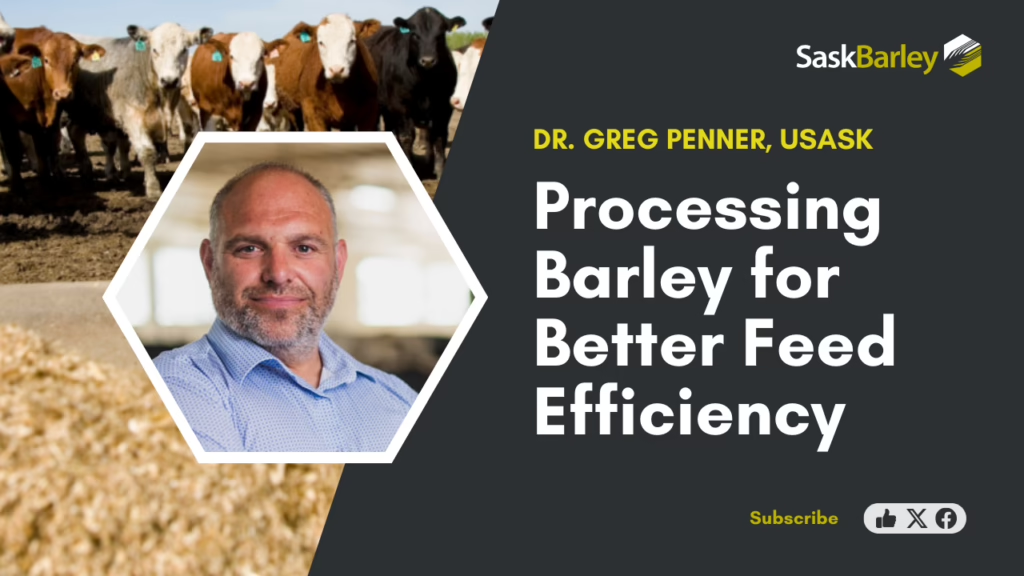
Watch Dr. Penner’s 2026 webinar on our YouTube channel to learn:
- Why barley shouldn’t be processed like corn
- How to reduce starch loss
- Target processing levels for barley
- Why moisture based methods are better
Research Rules…Pass It On
While those are the most tangible benefits of the project, there is another upside that will impact the next generation of farmers.
“My job also has a training component, and that’s the part of research that is often overlooked. I have the privilege of training technicians and numerous grad students while they learn about barley and feeding management of beef or dairy cattle. Some of those people are now working in the industry and serving as a new set of researchers. I find it so rewarding to see them develop and contribute in a way that I can’t. It’s a lot of fun to watch their careers develop.” – Dr. Greg Penner, University of Saskatchewan