Trends in Barley Varieties to Influence Your 2026 Seeding Plans
Including: 7 Barley Varieties for 2026
By Mitchell Japp, Research & Extension Manager
Is the Grass Greener?
Is there anyone who isn’t curious what their neighbour is growing? The old adage, “the grass is always greener on the other side of the fence,” comes to mind. Looking at a bumper crop certainly gets me wondering: “What is the yield going to be when it hits the bin?” “What happened in that field that was just right?” And, “What variety is that anyway?”
The Canadian Grain Commission (CGC) has been giving us part of the story from our “neighbours” since 2008. Each year they summarize the variety acreage data from the provincial crop insurance organizations. And, every year, I jump in and take a closer look at the trends. Although top spot doesn’t change often in malt barley, or even feed barley, there are still trends to look at, to see if any one variety is looking “greener on the other side”.
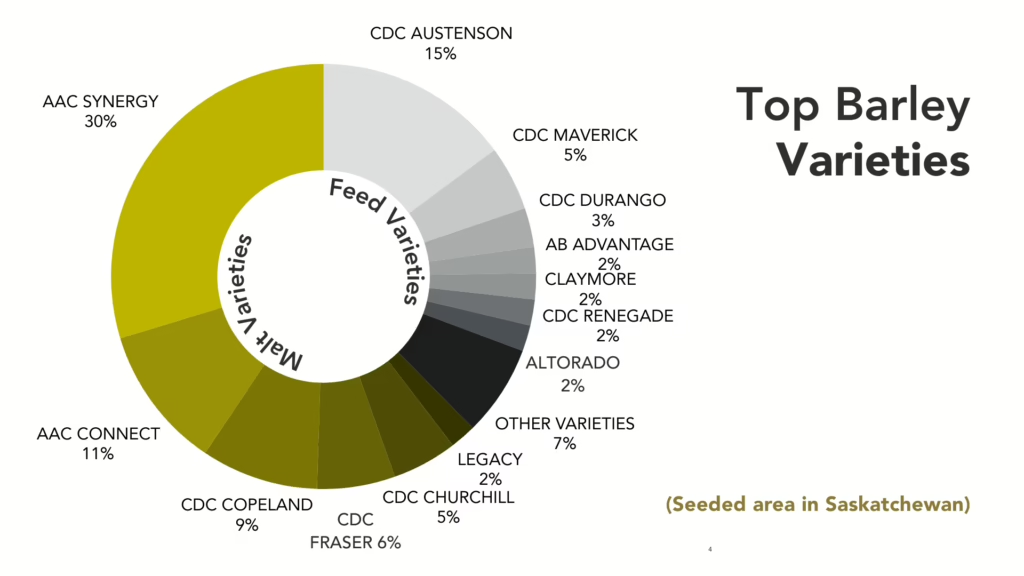
In 2025, the top five barley varieties in Saskatchewan made up 71%* of barley acres. Those top five are primarily malt – AAC Synergy, AAC Connect, CDC Copeland and CDC Fraser, with the feed variety CDC Austenson in second place.
Variety Trends Differ Across Provinces
The varieties grown in Saskatchewan often differ slightly from neighbouring provinces. Technically, the CGC reports on insured acres in British Columbia, Alberta, Saskatchewan and Manitoba, but it’s really Alberta and Saskatchewan that drive barley trends, making up nearly 93% of prairie barley production. The top five barley varieties on the Prairies are:
- AAC Synergy
- CDC Austenson
- Esma
- Sirish
- CDC Copeland
Although Sirish is registered as a malt barley, it is primarily grown and marketed as a feed barley. Both Esma and Sirish are popular in high yielding barley production areas in Alberta for their semi-dwarf trait and resistance to lodging, combined with a high yield potential.
Specifically on the malt side, CDC Copeland acreage continues to decline, while CDC Churchill is climbing rapidly. Prairie-wide, CDC Churchill has surpassed CDC Fraser, while in Saskatchewan CDC Fraser is still ahead.
On the feed side, CDC Austenson continues to dominate. Only 35% of Saskatchewan barley acres are planted to feed varieties, and CDC Austenson is 15% of all barley acres. The remaining 20% that is feed is split amongst several varieties. There are several new feed varieties that will be available in the next few years. These have higher yield potential than CDC Austenson.
New Varieties are Gaining Ground
One other trend I looked at this year was how new the varieties are that are being grown. We often talk about the slow pace of variety change, but as it turns out, there are a lot of acres being planted to new varieties. Nearly half of varieties sown have been registered since 2015.
| Range of Variety Registration Date – ALL Barley | Prairie Insured Acres | Proportion of Acreage* |
| Varieties since 2015 | 1,968,729 | 46% |
| 2005-2014 | 1,860,517 | 43% |
| 1995-2004 | 435,800 | 10% |
| Prior to 1995 | 25,049 | 1% |
SaskBarley invests significantly in both variety development and in gaining market acceptance for new malt varieties. SaskBarley funding has contributed to new varieties like – CDC Fraser, AAC Connect, CDC Churchill, and AAC Prairie on the malt side, and CDC Durango, AAC Lariat and AAC Stockton on the feed side.
CDC Fraser (2-row, hulled malt)
- High-yielding, strong-strawed 2-row malting barley known for large, plump kernels and lower protein; malt profile is often described as high extract, lower β-glucan, and strong friability versus common checks.
Tech sheet: CDC Fraser – CMBTC.com
AAC Connect (2-row, hulled malt)
- A western-Canada workhorse malt variety with short/strong straw and a reputation for solid FHB resistance (MR) alongside malt quality in the AC Metcalfe “neighbourhood” (with strong extract/friability noted in many bulletins).
Tech sheet: AAC Connect – CMBTC.com
CDC Churchill (2-row, hulled malt)
- Very high-yielding 2-row malt with strong straw and lower grain protein; often positioned as a strong option where you want top-end agronomics while still targeting malt. (CMBTC)
Tech sheet: CDC Churchill – CMBTC.com
AAC Prairie (2-row, hulled malt)
- Newer 2-row malting barley (registered 2021) highlighted for good yield + excellent grain quality and a malting profile often described as similar to AC Metcalfe (including very strong enzyme potential in some summaries). (CMBTC)
Tech sheet: AAC Prairie – CMBTC.com
CDC Durango (2-row feed)
- A very high-yielding 2-row feed with short, strong straw and strong lodging tolerance; positioned by seed sellers as a modern “replacement-type” option where Austenson has been common.
Tech sheet: CDC Durango – SeCan.com
AAC Lariat (2-row, general purpose/feed)
- High-yielding, shorter-stature feed/general purpose barley with good standability and high kernel weight/plumpness; commonly promoted for strong overall disease package (incl. rust/smut/blotch resistance).
Tech sheet: AAC Lariat – Canterra.com
AAC Stockton (2-row, general purpose/feed)
- A 2-row feed/general purpose option combining good yield + strong straw with improved FHB resistance; often recommended where FHB risk is higher (or you just like sleeping at night).
Tech sheet: AAC Stockton – Secan.com
Choosing a Winner for 2026
Looking over the fence at the neighbours is only a small step in considering what barley variety to plant in 2026.
- Consider the traits that are important on your farm – disease resistance, standability, yield potential.
- Check with your buyers to see what varieties will be in the most demand.
- Check seed availability.
There are a lot of interesting varieties available now, or will be soon. Try onethem out and see if the neighbours are looking over your fence next year.
* percentages are calculated without including acres for which the variety was not declared.
Additional Resources:
- Canadian Malting Barley Technical Centre’s (CMBTC) 2026-27 Recommended Malting Barley Variety List.
- Canadian Grain Commission’s Quality of Canadian Barley in 2025
- SaskSeed Guide 2026 Varieties of Grain Crops