How to Interpret Your Seed Test Results
Every crop starts with a single seed. And while most of the focus goes into fertility programs, weed control, and choosing varieties, seed quality is the foundation that everything else relies on. That’s why SaskBarley strongly recommends running a full seed test before every season—whether you’re planting homegrown bin-run seed or purchased seed.
A seed test is one of the cheapest inputs you can buy, and arguably one of the most important. Here’s how to interpret seed test results and apply them directly to your barley seeding plans this spring.

1. Germination: Your Seed Lot’s Maximum Potential
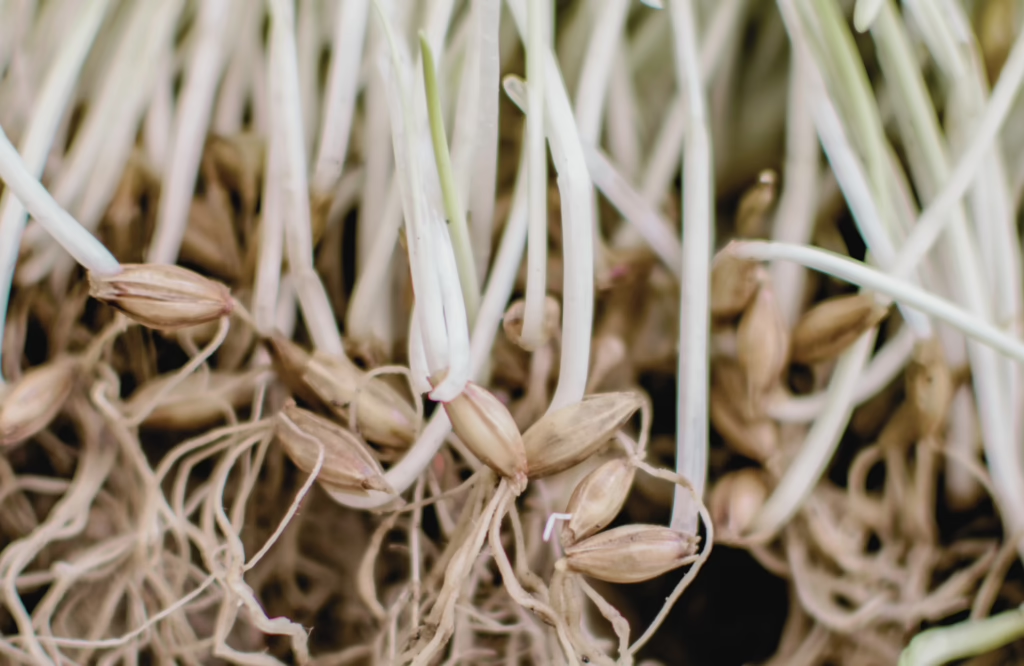
Germination tells you what percentage of seeds will sprout under ideal conditions—perfect moisture, oxygen, and temperature.
What it means for barley:
- Barley germ tests include a brief cold period to break dormancy, then seeds are germinated at 20°C for seven days.
- High germination is good—but it only reflects ideal field conditions, which Saskatchewan barley fields rarely offer in the early spring.
- Poor germination is a signal to look for a different seed source.
Watch for these categories in the report:
- Fresh seeds: absorbed water but didn’t germinate—could be dormant.
- Hard seeds: didn’t take up water; uncommon in barley.
- Abnormal seedlings: sprout but are missing critical structures; won’t survive.
- Dead seeds: fully nonviable.
Key takeaway:
Even if a barley seed lot has strong germination, don’t rely on this number alone—especially after drought or when seed has experienced tough harvest conditions that cause microcracking and lower seedling survival.
The average germination results for the province in each commodity category are available in the annual Provincial Seed Survey.

2. Vigour: How Seed Performs in Real-World Conditions
Vigour is often more important than germination for barley. It predicts how well seedlings emerge in cool, stressful early spring soils—exactly the conditions most barley goes into.
Why vigour matters in barley:
- Low vigour seed produces uneven emergence and weak early growth.
- Barley stands with poor vigour have lower competitiveness against weeds like wild oats.
- Barley vigour often drops before germination does—making it an early signal of trouble.
If your vigour score is low:
- Expect slower emergence.
- Increase your seeding rate to compensate only if disease pressure is low.
- Consider treating with a seed treatment to protect early seedlings.
But remember: you can’t fix truly poor seed with seeding rate alone.

3. Disease Screening: Protecting Your Stand from the Start
Seedborne diseases impact stand establishment, early root health, and overall yield potential. For barley, the key ones to watch are:
Fusarium spp. (general root rot complex):
- Threshold: 10%
- Seed treatments are recommended at or above this level.
Fusarium graminearum:
- Threshold: 2%
- Increasingly important in many areas of Saskatchewan.
- Even at low levels, it can weaken seedlings and contribute to root rot and later season issues.
Check out the interim results from the annual seed survey to understand if you’re in a high-risk zone for Fusarium spp. and Fusarium graminearum.
Loose Smut (Ustilago nuda):
- Maximum allowable: 2% (Seeds Act specification)
- Requires a systemic seed treatment—contact fungicides won’t control it.
Why disease testing matters:
Barley seed-borne diseases aren’t always visible, and infection levels can increase when seed is stressed by drought or harvested under hot, dry conditions. Even a “dry year” doesn’t guarantee clean seed.
If your seed test shows elevated disease, a fungicidal seed treatment targeted to the pathogens present is essential.

4. Thousand Kernel Weight (TKW): The Key to Accurate Seeding Rates
TKW tells you the average weight of 1,000 seeds and is critical for calculating a seeding rate that hits your target plant stand.
For barley:
- Typical TKW: 30–50 g
- Larger seed (higher TKW) means fewer seeds per pound, requiring a higher seeding rate.
- Smaller seed after a drought year is common—don’t assume last year’s TKW applies this year.
Target plant stand for barley
Why TKW matters this year more than ever
Dry years reduce seed fill → lower TKW → more seeds per pound → lower seeding rate if you don’t adjust.
Spring seed tests can differ dramatically from fall tests, so retesting pays.

5. Seedling Survivability: Your Final Calculation Factor
Germination ≠ final stand.
Barley’s actual seedling survival is typically 5–15% below the germination number, depending on:
- Seeding into cold soil
- Seed-placed fertilizer
- Seeding speed and depth
- Soil texture
- Disease or insect pressure
If your seed is cracked, low vigour, or carries pathogens, survivability may be even lower.
Learn more on seedling survivability in Mortal Danger: Understanding Seedling Mortality
Bottom line:
Always calculate your seeding rate using:
germination, vigour, TKW, AND your best estimate of survivability.

6. Should You Retest Seed in Spring? (Short answer: YES.)
Barley seed stored over winter can lose:
- Vigour
- Germination
- Seed coat integrity
This is especially true in hot, dry harvest years. Seed can look fine in bins but experience additional cracking during handling and cleaning.
Spring seed test results are one of the most important pre-season tools you can use.

Final Thoughts
For barley growers, seed testing isn’t just a box to check—it’s a strategic tool. Seed tests help you:
- Choose the right seed lot
- Decide whether a seed treatment is necessary
- Calculate accurate seeding rates
- Predict field emergence
- Reduce risk in a tight spring window
Your seed is the start of your barley crop. Comprehensive spring seed test results give you the information you need to set up the season for success.
Read more: A Quick Checklist for Seeding Malt Barley in Saskatchewan