
Barley Market Report: Largest December 31st Canadian Barley Stocks Since 2019
This barley market report was provided by Leftfield Commodity Research.
Key Takeaways
- StatsCan reported 5.69 million tonnes of Canadian barley stocks on December 31, the highest level since 2019.
- Strong 2025 barley production and larger carry-in supplies contributed to the increase in available stocks.
- Feed demand and exports remained strong early in the season, helping absorb part of the larger supply.
- Barley competed well with other feed grains early in the marketing year, encouraging livestock feeding demand.
- Ending stocks are expected to grow by the end of 2025/26, creating a supply cushion heading into the 2026 crop year.
In February StatsCan provided estimates for December 31st stocks and an updated supply and disposition table. While this stocks release doesn’t get the same kind of attention that acreage and production reports typically receive, it’s helpful in reviewing what happened early in the season and for reevaluating estimates for the remainder of the 2025/26 crop year.
December 31 Barley Stocks in Canada Reach Highest Level Since 2019
StatsCan showed December 31st barley stocks at 5.69 mln tonnes, 820,000 tonnes larger than last year and the highest since 2019. The increase in stocks was not a surprise after record yields last summer led to a 1.6 mln tonne increase in production, to 9.73 mln tonnes. The old-crop carryin was also higher, further adding to supplies. But while stocks were the biggest in 6 years, they are still below what was common prior to the 2019/20 season. In other words, barley supplies are comfortable, but not ‘burdensome’ from a historical context.

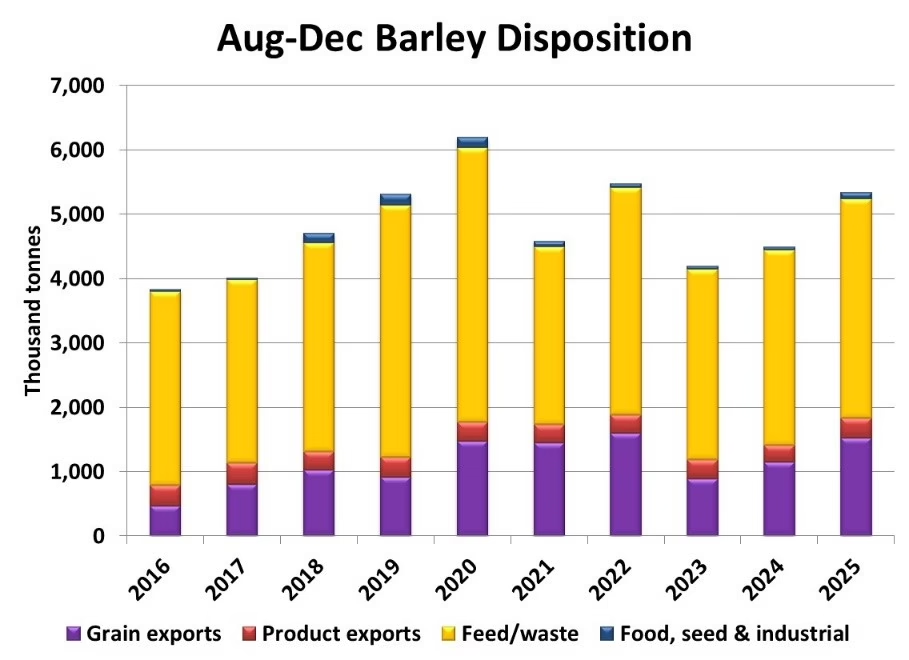
The reason the year-over-year increase in stocks is smaller than the rise in production is because barley usage was also higher. StatsCan estimated total August to December disappearance at 5.34 mln tonnes, up 850,000 tonnes from the same period last year, and the second highest since 2020.
Strong Feed Barley Demand Supports Early Season Disappearance
Feed/waste/dockage was estimated at 3.40 mln tonnes, the most for the period in three years. The FWD category acts as a ‘catch all’ to make the overall S&D figures balance, and livestock feeding is difficult to measure accurately, so the number is sometimes taken with a grain of salt. But larger feed usage makes sense as barley was competitively priced relative to other feed grains through the fall and early winter, which encouraged more demand.
Canadian Barley Exports Increase with Strong Demand from China
Exports were also strong through the first part of the season. Grain exports were reported at 1.53 mln tonnes, the most since 2020. As usual, this was primarily driven by China, although there was increased movement to other countries as well, including the first shipments to Saudi Arabia in a number of years. Product exports were also up at 306,200 tonnes in grain equivalent terms, the largest since 2019. Industrial use is relatively small, but was also shown to be higher, at 95,300 tonnes.
Barley Market Outlook: Can Demand Stay Strong Through Spring?
A key part of the barley outlook going forward is if demand can remain strong through the spring and summer. Livestock feeding was up partially because barley was cheap relative to other feed grains. However, US corn has become more competitive into southern Alberta more recently, and abundant supplies of other cereals in western Canada may erode barley usage in some rations around the margins. Canadian barley being competitive in world markets allowed for larger shipments early in the season. And while global demand is strong, big crops in other key exporters such as Australia and Argentina means importing countries have options. This limits how high Canadian barley prices can go before demand starts to get crimped.
What Larger Ending Stocks Could Mean for the 2026 Barley Crop
Even if usage remains steady through the balance of the season, Canadian barley stocks will be bigger at the end of 2025/26, meaning there will be a supply cushion going into the next harvest. When combined with expectations for higher seeded area in spring, the setup could be for potentially even larger supplies in 2026/27. At the same time, it’s premature to make that assumption, as a return to average yields from last year’s record could result in a smaller crop in 2026, even if plantings are higher.
Find more barley market reports here:
- Barley Market Report: Smaller North American Crops and Low Malt Selection Tighten 2026/27 Supplies
- Barley Market Report: Canadian Barley Stocks Tighten Ahead of 2026/27 Marketing Year
- Barley Market Report: Tighter Global Supplies Set to Support Canadian Barley Prices in 2026/27
- Barley Market Report: USDA and StatsCan Update 2026 Barley Acreage Estimates
- Barley Market Report: Strong Demand Pulls Down Canadian Barley Ending Stocks in 2025/26