
Barley Market Report: USDA Increases US Corn Production Estimates
This barley market report was provided by Leftfield Commodity Research.
Key Takeaways
- USDA’s January reports raised US corn production to a record 17.0 billion bushels, impacting market trends significantly.
- Lower US corn prices will pressure barley prices, affecting the feed grain market in Canada.
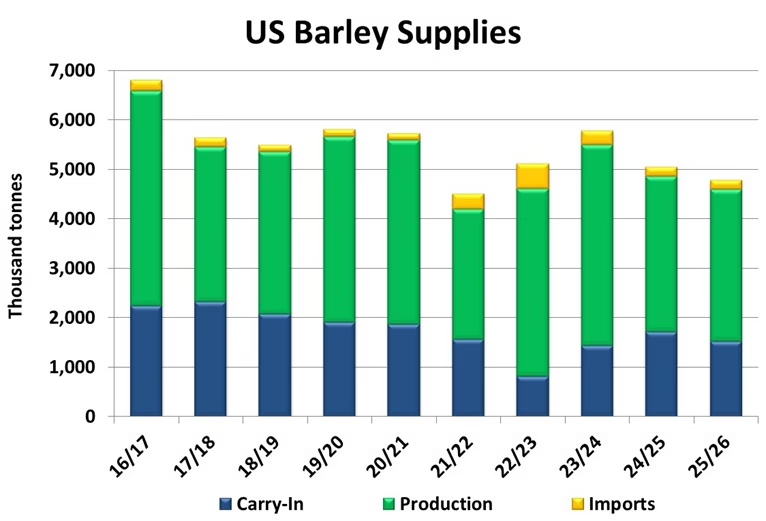
- US barley production remains at 3.1 million tonnes, with limited change and projected imports staying flat.
- USDA forecasts historically low US barley demand of 3.2 million tonnes for 2025/26, driven by reduced malting demand.
- Preliminary projections indicate potential declines in US corn plantings for 2026, affecting future supply.
USDA Raises US Corn Production in January Report
Each year USDA releases several key reports in January, including updated production estimates, December 1st stocks and revised supply and disposition tables. These reports often set the tone for the next two months of trade as they bridge the gap between the holiday lull and when markets start to focus more intently on new-crop production and the 2026/27 outlook.
Record Corn Supplies Pressure Futures Prices
This year USDA delivered a bearish surprise for corn. US production was increased to 17.0 bln bushels, easily a record, after raising yield to an all-time high of 186.5 bu/acre, while harvested area was also revised upward. Even with expectations for record demand, the 2025/26 US carryout projection was bumped to 2.2 bln bushels, the largest in nearly a decade.
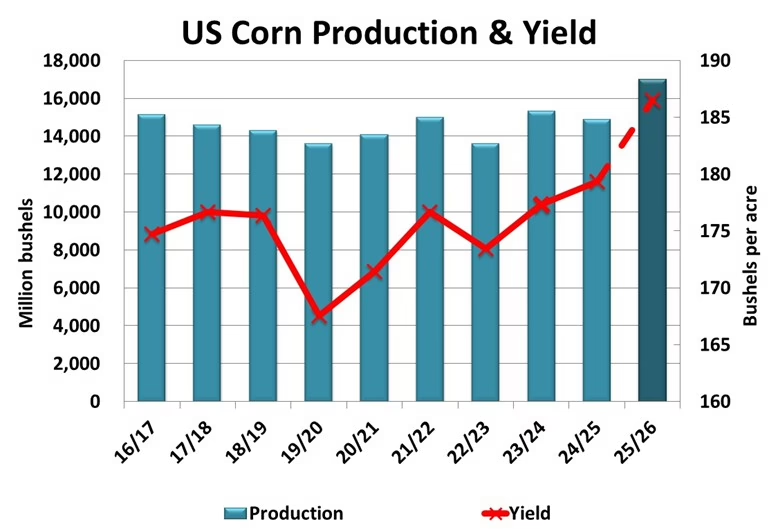
As one might expect, corn prices pulled back after the report, particularly as traders were caught ‘leaning the wrong way’ in their assumption of yield cuts. US corn futures lost over $0.20/bu the day of the release, down to their lowest level since August, and have only recovered a small portion of that in the weeks since.
What Lower US Corn Prices Mean for Canadian Barley
The US corn market has a significant influence on prairie feed grain prices. StatsCan shows western Canadian corn imports running at a similar pace to last season from September to November, with new commitments slowing down after barley became more competitively priced through the fall and early winter. But the more recent pullback in corn prices, due both to the decline in futures values as well as softer basis levels after Manitoba harvested a record crop, has caused corn to become relatively cheaper. This may not trigger a massive influx of imports, but it will act as a headwind for barley prices if the corn market remains under pressure, which may temper some of the seasonal strength that is typically seen in feed barley through the spring.
USDA Barley Production Estimates Show Limited Change
USDA’s updated figures for US barley didn’t contain many surprises. Production was left unchanged at 3.1 mln tonnes, behind only 2021 for a historic low as seeded area continues to shrink. However, the December 1st stocks data suggests the crop may be understated. Despite the (reported) small production, imports are projected to stay flat at just below 200,000 tonnes, compared to the 5-year average of closer to 300,000 tonnes. Canadian export data affirms the slow early pace of movement into the US, a trend that doesn’t seem likely to change a great deal in the coming months. While the US is an important market for Canada given its close proximity and well-established long-term relationships, it has represented less than 10% of total shipments the past few seasons, which limits the impact of slower buying on the overall Canadian export outlook.
Weak US Barley Demand Weighs on Market Outlook
USDA is forecasting US barley demand to be a historically low 3.2 mln tonnes in 2025/26, compared to a 5-year average of 3.8 mln tonnes. Unlike in Canada where livestock feeding is the largest source of barley consumption, US barley demand is primarily for malting. This has resulted in reduced usage overall, given the general trend towards lower malt demand in recent years.
2026 US Acreage Forecast
While it’s still early, preliminary projections suggest US corn plantings could decline in 2026. This points to lower supplies in 2026/27 if the record yields from last season aren’t repeated. Barley seeded area in the US is likely to remain near historic lows next year.
Find more barley market reports here:
- Barley Market Report: Smaller North American Crops and Low Malt Selection Tighten 2026/27 Supplies
- Barley Market Report: Canadian Barley Stocks Tighten Ahead of 2026/27 Marketing Year
- Barley Market Report: Tighter Global Supplies Set to Support Canadian Barley Prices in 2026/27
- Barley Market Report: USDA and StatsCan Update 2026 Barley Acreage Estimates
- Barley Market Report: Strong Demand Pulls Down Canadian Barley Ending Stocks in 2025/26